
Home / Solutions
Process-led solutions shaped around your operation.
Systemix starts with the real process, then determines whether the right response is redesign, configuration, integration, automation or no build.
Reference solutions and implementation evidence.
The implemented example shows work delivered for a real business. The reference prototype shows a working control pattern built with synthetic demonstration data.
B2B order intake and approval integration
Built after examining the client’s existing message-to-order process. The workflow replaces an avoidable manual re-entry step with structured AppSheet intake, explicit customer-group pricing selection, human approval, PDF generation and record updates.
Service Completion-to-Cash control flow
Completed with synthetic demonstration data. The prototype connects structured field completion, automated control checks, owned exceptions, supervisor review and invoice-draft preparation. It is one process pattern, not the boundary of Systemix’s offer.
B2B order intake: from message re-entry to structured approval.
This workflow was built for a Philippine B2B product distributor with a catalogue of more than 450 products. It follows the client’s actual ordering roles and rules while improving the handoffs between intake, pricing, approval, document generation and records.
Client profile
Philippine B2B product distributor
Process
Customer order intake and approval
Catalogue
More than 450 products
Scope
Structured intake, pricing selection, approval, PDF generation and record update
Evidence status
Implemented workflow; quantitative post-implementation measurement not yet completed
Customer messages were manually copied into an order receipt
The client’s customers placed orders through a messaging platform. Staff then re-entered the order into a receipt. The client reported that this normally took about 10–15 minutes per order and created additional opportunities for transcription, quantity or item-selection mistakes.
The implemented flow followed the client's actual roles
A guided AppSheet intake captures the customer and order lines. An authorised business user selects the applicable customer-group pricing, and the priced summary is routed to the client’s authorised approver. Telegram was used as the approval channel in this implementation; the channel is not the core solution.
Approval happens before the printable document is produced
The workflow validates the order data and stable item identities, applies the selected pricing rules, creates the approval summary and records approval or rejection. Once approved, the workflow generates the print-ready PDF and updates the structured order and order-line records.
Less re-entry, clearer checkpoints and more consistent outputs
Order details can move from structured intake through pricing, approval and document generation without staff repeatedly copying the same information. Pricing selection and approval are explicit, while approved orders produce a repeatable PDF and structured record set.
The old process time is reported; the new outcome is not yet quantified
Client-reported baseline: receipt preparation normally took about 10–15 minutes per order. Quantitative post-implementation measurement has not yet been completed.
Service Completion-to-Cash: from field completion to a controlled finance handoff.
This completed reference prototype models a service Completion-to-Cash process using synthetic demonstration data. It shows how structured service evidence, automated checks, owned exceptions, supervisor review and invoice-draft preparation can work together.
A job progresses only when its required evidence, operational checks and approval conditions are satisfied.
The reference flow begins with an assigned work order and a structured technician completion. The workflow normalises the data, retrieves the relevant work-order and pricing context, checks configured rules and routes the case to correction, safety hold, billing hold or supervisor review. Approval controls preparation of the structured invoice draft.
Evidence class
Completed reference prototype
Demonstration data
Synthetic, not a client record set
Illustrative interface
AppSheet; replaceable by an existing client system
Control layer
n8n with human approval before finance handoff
Designed reference prototype — adapted to each client’s real environment
This is a working reference pattern, not an off-the-shelf product. Any client implementation would be adapted to the organisation’s existing software, roles, data, approvals and operating rules.
Work-order context
Technician completion
Validate and price
Route exceptions
Supervisor review
Finance-ready draft
See how the control chain works from field evidence to finance review.
Each screen is included because it demonstrates a business control: consistent capture, automated validation, visible exceptions, human authority or a traceable handoff.
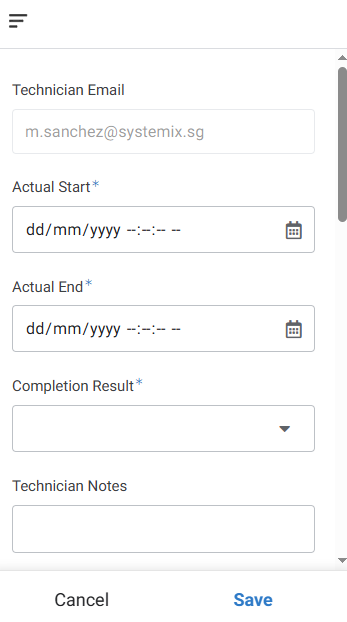
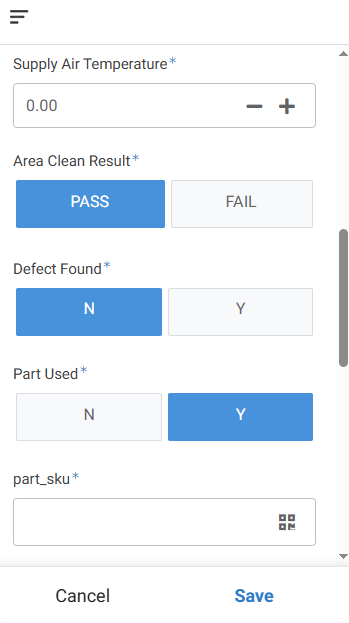
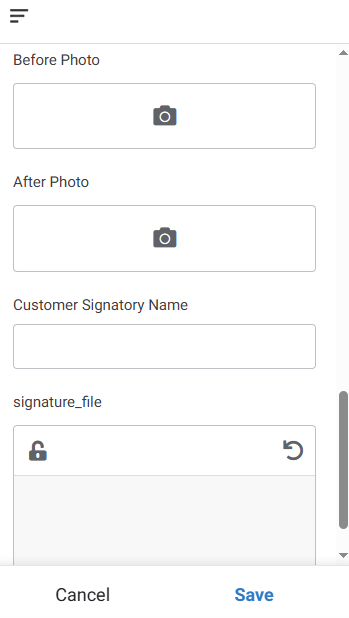
Capture the information that drives later decisions
The technician records timing, result, service controls, parts, before-and-after evidence and customer sign-off in one structured submission. AppSheet is the demonstration interface; an existing client system could perform the same role.
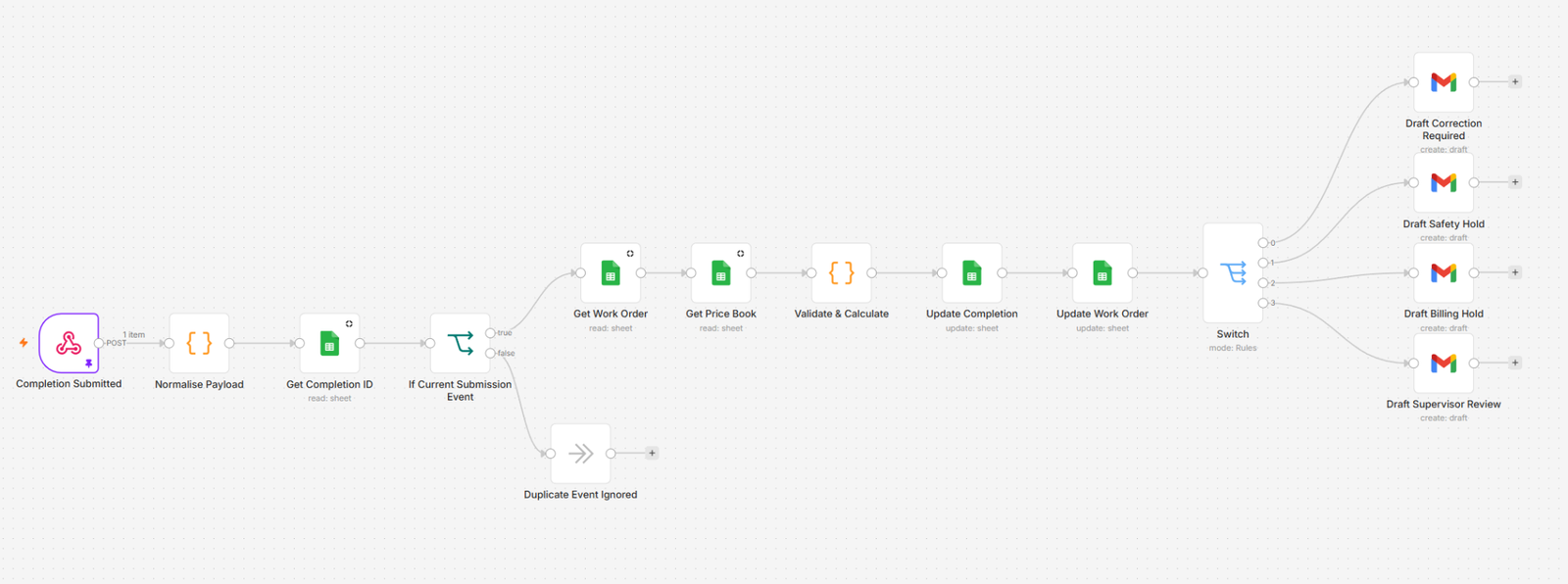
Normalise once, then apply the relevant evidence and billing rules
The control layer retrieves the work order and price book, calculates billing values, prevents duplicate events and routes each case into correction, safety hold, billing hold or supervisor review.
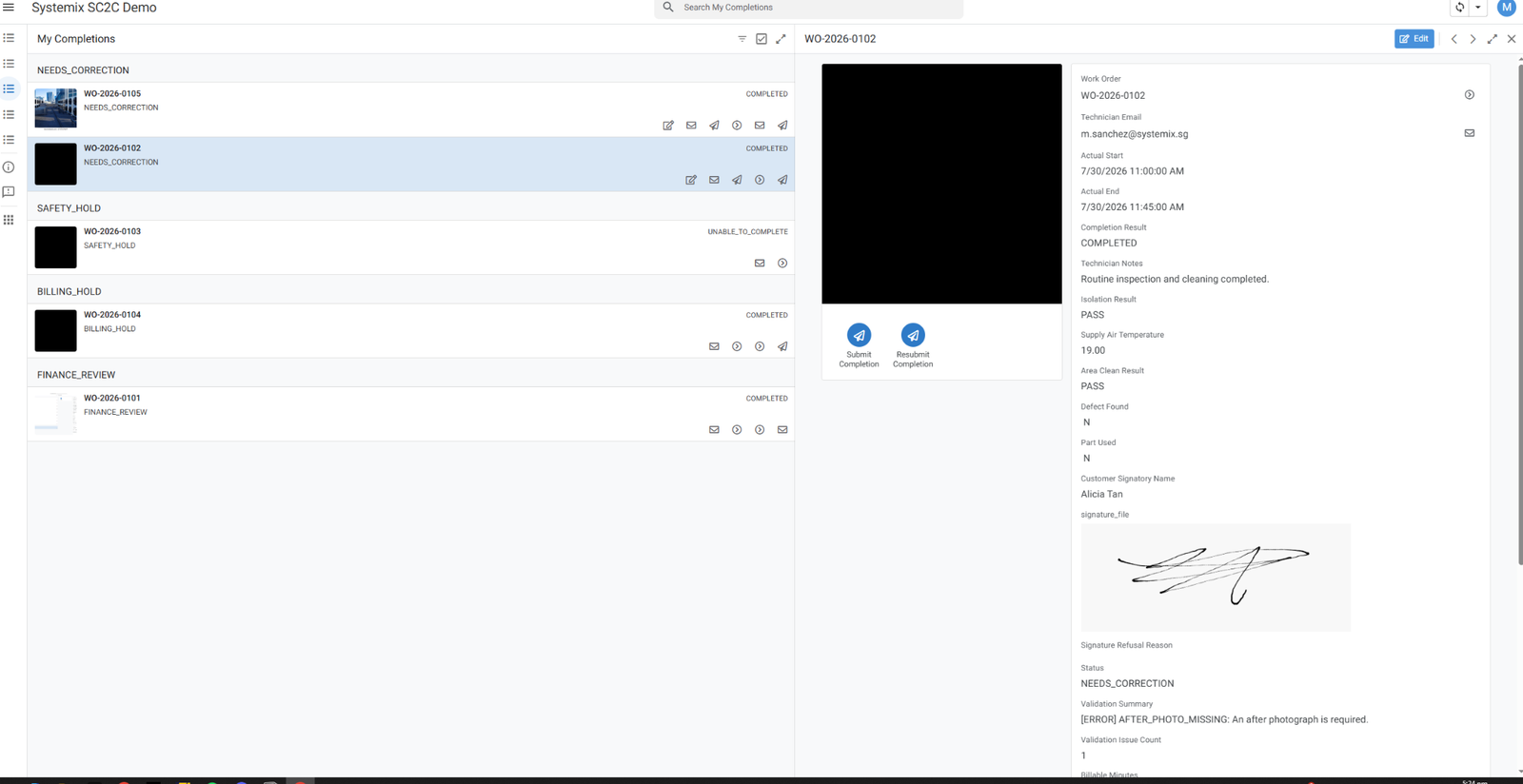
Blocked work stays visible instead of silently progressing
A missing after-service photograph is returned for correction. The same queue distinguishes correction, safety, billing and finance-review states so the responsible person can act on the right issue.
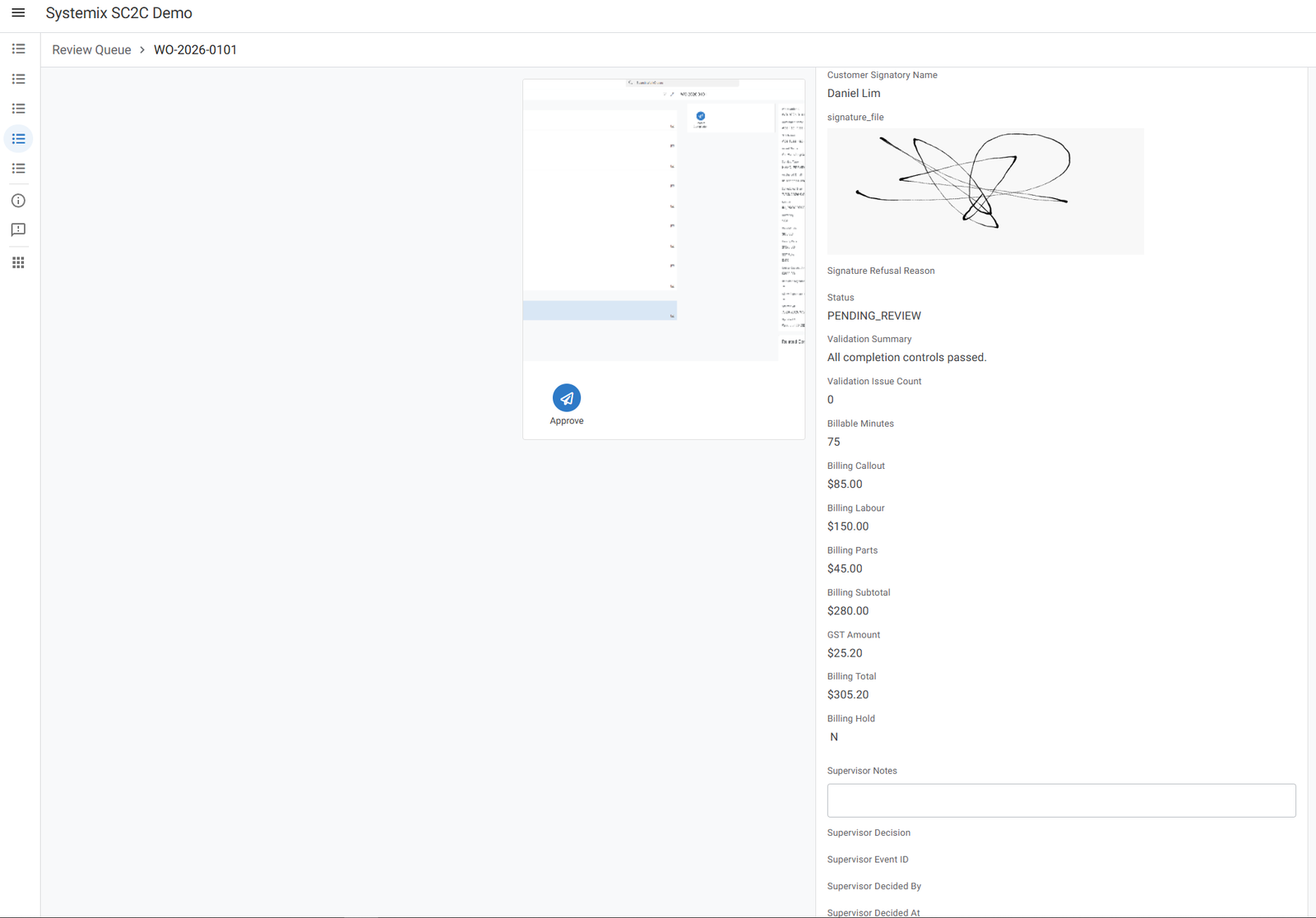
An authorised reviewer sees the evidence and billing preview before approval
The supervisor reviews validation status, customer evidence, billable time, call-out, labour, parts, GST and total. Approval remains a human decision.
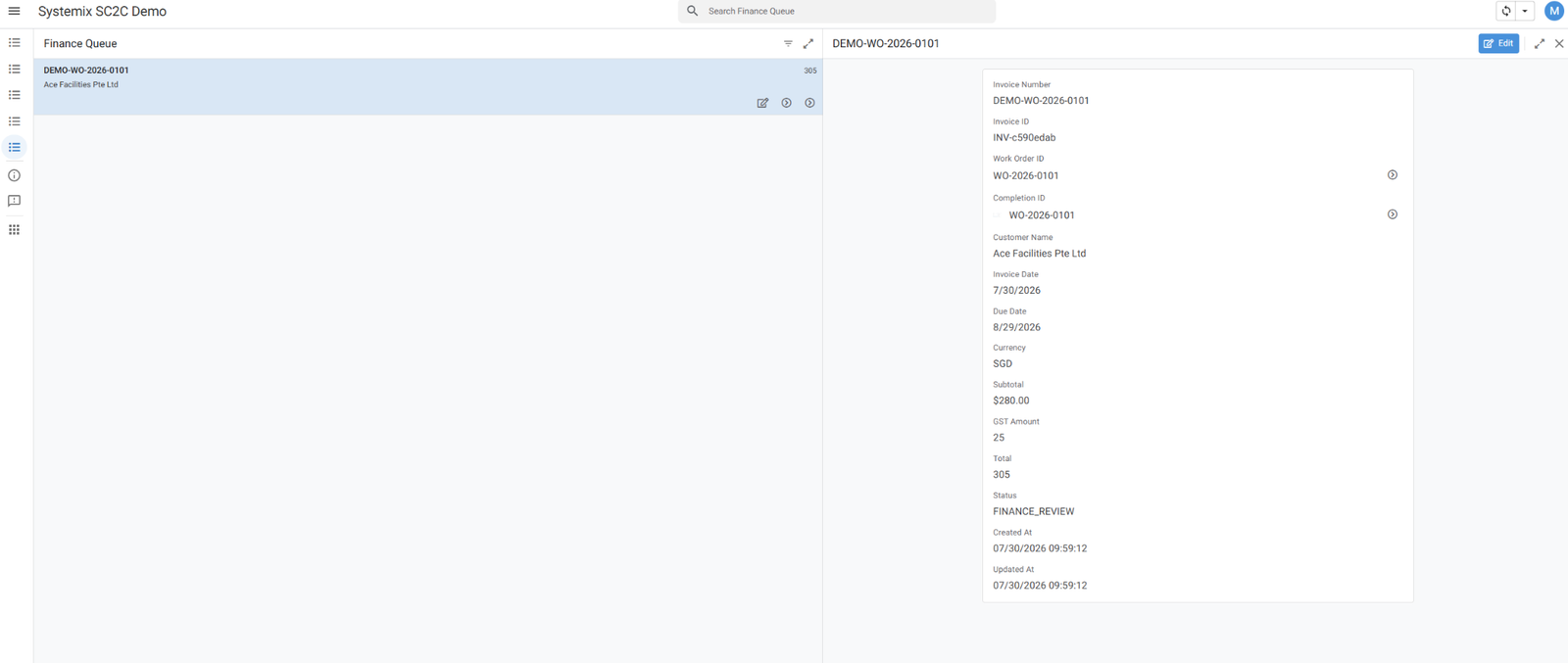
Only approved operational data becomes an invoice draft
The finance queue receives a linked draft with work-order, customer, dates and totals. It is prepared for finance review; the prototype does not autonomously post or issue an invoice.
Evidence status: the screens use synthetic demonstration records and show the completed prototype’s control logic; they are not production-performance results.
Evidence, decisions and handoffs become explicit
- Structured job context, readings, parts, notes, photographs and customer signature
- Normalised identifiers, numbers, booleans and status values before rules are evaluated
- Configured evidence, numeric, price-book, labour, parts, GST and commercial-limit checks
- Duplicate-event protection and named exception outcomes
- Supervisor approval or correction request before invoice-draft preparation
Fewer incomplete jobs, clearer exception ownership and a cleaner finance handoff
- Fewer incomplete or unauthorised jobs reaching the finance queue
- Clearer ownership of correction, safety and commercial exceptions
- Less manual chasing across disconnected forms, messages and spreadsheets
- A more consistent billing preview before finance review
- Traceable links between work order, completion, approval and invoice draft
Billing-readiness gate
A technician selecting ‘complete’ does not by itself release the job. Required evidence and configured controls must pass first.
Owned exception states
Incomplete, safety-sensitive and commercially blocked cases remain visible and assigned to the responsible role instead of silently progressing.
Controlled finance handoff
Approved operational data is converted into a structured invoice draft linked to the work-order and completion records by stable identifiers.
Authority boundary: The prototype surfaces and routes recorded safety-critical results; it does not make a safety diagnosis or replace an authorised reviewer. It prepares an invoice draft rather than autonomously posting or issuing a financial record. Production rules, authorities and system connections must be confirmed in the client diagnostic.
What completion of the prototype supports
The build is evidence that Systemix can assemble the following pattern with synthetic data:
- Structured field completion and evidence capture
- Rule-based validation and distinct exception routes
- A consolidated supervisor review queue
- Approval-controlled invoice-draft preparation
- Stable linkage across operational and finance-facing records
What remains to be validated with customers
Before production, a client diagnostic must confirm that the process is frequent and costly enough to justify action, define the current baseline and roles, confirm business rules and system access, and agree how operational results will be measured.
How this reference supports a process-first engagement
Completion-to-Cash is a capability reference, not a predetermined answer. A process conversation or paid diagnostic may show that service intake, dispatch, defect-to-quote, parts, purchasing, invoicing or another recurring process is the stronger starting point.
Want to test whether a similar control pattern fits your operation?
The right next step is a process conversation around one recent case—not an assumption that the same design or result transfers to your business.
Process and systems integration for Singapore B2B operations. We map real workflows, connect existing tools and control valuable handoffs around a measurable outcome.
© 2026 Systemix. All rights reserved.
Singapore-focused process and systems integration.